 Trinity API Reference
 #include <dom_doc.h>
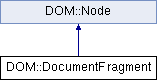
Public Member Functions | |
| DocumentFragment (const DocumentFragment &other) | |
| DocumentFragment (const Node &other) | |
| DocumentFragment & | operator= (const Node &other) |
| DocumentFragment & | operator= (const DocumentFragment &other) |
 Public Member Functions inherited from DOM::Node Public Member Functions inherited from DOM::Node | |
| Node (const Node &other) | |
| Node (NodeImpl *_impl) | |
| Node & | operator= (const Node &other) |
| bool | operator== (const Node &other) const |
| bool | operator!= (const Node &other) const |
| DOMString | nodeName () const |
| DOMString | nodeValue () const |
| void | setNodeValue (const DOMString &) |
| unsigned short | nodeType () const |
| Node | parentNode () const |
| NodeList | childNodes () const |
| Node | firstChild () const |
| Node | lastChild () const |
| Node | previousSibling () const |
| Node | nextSibling () const |
| NamedNodeMap | attributes () const |
| Document | ownerDocument () const |
| Node | insertBefore (const Node &newChild, const Node &refChild) |
| Node | replaceChild (const Node &newChild, const Node &oldChild) |
| Node | removeChild (const Node &oldChild) |
| Node | appendChild (const Node &newChild) |
| bool | hasChildNodes () |
| Node | cloneNode (bool deep) |
| void | normalize () |
| bool | isSupported (const DOMString &feature, const DOMString &version) const |
| DOMString | namespaceURI () const |
| DOMString | prefix () const |
| void | setPrefix (const DOMString &prefix) |
| DOMString | localName () const |
| bool | hasAttributes () |
| DOMString | textContent () const |
| void | setTextContent (const DOMString &content) const |
| void | addEventListener (const DOMString &type, EventListener *listener, const bool useCapture) |
| void | removeEventListener (const DOMString &type, EventListener *listener, bool useCapture) |
| bool | dispatchEvent (const Event &evt) |
| TQ_UINT32 | elementId () const |
| bool | isNull () const |
| NodeImpl * | handle () const |
| unsigned long | index () const |
| TQString | toHTML () TDE_DEPRECATED |
| void | applyChanges () |
| void | getCursor (int offset, int &_x, int &_y, int &height) TDE_DEPRECATED |
| TQRect | getRect () |
Protected Member Functions | |
| DocumentFragment (DocumentFragmentImpl *i) | |
Friends | |
| class | Document |
| class | HTMLElementImpl |
| class | Range |
Additional Inherited Members | |
| Public Types inherited from DOM::Node | |
| enum | NodeType { ELEMENT_NODE = 1 , ATTRIBUTE_NODE = 2 , TEXT_NODE = 3 , CDATA_SECTION_NODE = 4 , ENTITY_REFERENCE_NODE = 5 , ENTITY_NODE = 6 , PROCESSING_INSTRUCTION_NODE = 7 , COMMENT_NODE = 8 , DOCUMENT_NODE = 9 , DOCUMENT_TYPE_NODE = 10 , DOCUMENT_FRAGMENT_NODE = 11 , NOTATION_NODE = 12 } |
| Protected Attributes inherited from DOM::Node | |
| NodeImpl * | impl |
Detailed Description
DocumentFragment is a "lightweight" or "minimal" Document object.
It is very common to want to be able to extract a portion of a document's tree or to create a new fragment of a document. Imagine implementing a user command like cut or rearranging a document by moving fragments around. It is desirable to have an object which can hold such fragments and it is quite natural to use a Node for this purpose. While it is true that a Document object could fulfil this role, a Document object can potentially be a heavyweight object, depending on the underlying implementation. What is really needed for this is a very lightweight object. DocumentFragment is such an object.
Furthermore, various operations – such as inserting nodes as children of another Node – may take DocumentFragment objects as arguments; this results in all the child nodes of the DocumentFragment being moved to the child list of this node.
The children of a DocumentFragment node are zero or more nodes representing the tops of any sub-trees defining the structure of the document. DocumentFragment nodes do not need to be well-formed XML documents (although they do need to follow the rules imposed upon well-formed XML parsed entities, which can have multiple top nodes). For example, a DocumentFragment might have only one child and that child node could be a Text node. Such a structure model represents neither an HTML document nor a well-formed XML document.
When a DocumentFragment is inserted into a Document (or indeed any other Node that may take children) the children of the DocumentFragment and not the DocumentFragment itself are inserted into the Node . This makes the DocumentFragment very useful when the user wishes to create nodes that are siblings; the DocumentFragment acts as the parent of these nodes so that the user can use the standard methods from the Node interface, such as insertBefore() and appendChild() .
Constructor & Destructor Documentation
◆ DocumentFragment() [1/4]
| DOM::DocumentFragment::DocumentFragment | ( | ) |
Definition at line 560 of file dom_doc.cpp.
◆ DocumentFragment() [2/4]
| DOM::DocumentFragment::DocumentFragment | ( | const DocumentFragment & | other | ) |
Definition at line 564 of file dom_doc.cpp.
◆ DocumentFragment() [3/4]
|
inline |
◆ ~DocumentFragment()
| DOM::DocumentFragment::~DocumentFragment | ( | ) |
Definition at line 588 of file dom_doc.cpp.
◆ DocumentFragment() [4/4]
|
protected |
Definition at line 592 of file dom_doc.cpp.
Member Function Documentation
◆ operator=() [1/2]
| DocumentFragment & DOM::DocumentFragment::operator= | ( | const DocumentFragment & | other | ) |
Definition at line 582 of file dom_doc.cpp.
◆ operator=() [2/2]
| DocumentFragment & DOM::DocumentFragment::operator= | ( | const Node & | other | ) |
Definition at line 568 of file dom_doc.cpp.
Friends And Related Function Documentation
◆ Document
◆ HTMLElementImpl
◆ Range
The documentation for this class was generated from the following files: